


In 1974, a group of women in a tiny Himalayan village stood between a forest and the men who came to cut it down. They had no weapons, no political influence, and no money. What happened next would help change India’s environmental history.
The men came with axes. The women came with nothing.
Well, almost nothing.
They had a forest they weren’t willing to lose.
And as it turned out, that was enough.
The perfect day to cut down a forest.
March 26, 1974. Reni, a tiny village in the Himalayas.
A logging crew arrived with official permission to cut down trees. The village’s men had been called away to collect government compensation, a conveniently timed absence that accounts of the movement describe as deliberate.
The contractors expected an easy day.
They hadn’t accounted for Gaura Devi.
A local woman with no political influence or formal environmental training, Gaura Devi understood something the contractors didn’t. Those trees weren’t simply timber. They provided firewood, fodder, and resources that sustained the village. Their roots helped hold the fragile mountain slopes together.
Cutting the forest meant threatening everything the community depended on.
When a young girl warned her that the loggers were approaching, Gaura Devi gathered 26 other women and marched towards the trees.
The workers ordered them to leave. The women refused. Threats followed, but the women stood between the axes and the forest, ready to protect the trees with their own bodies.
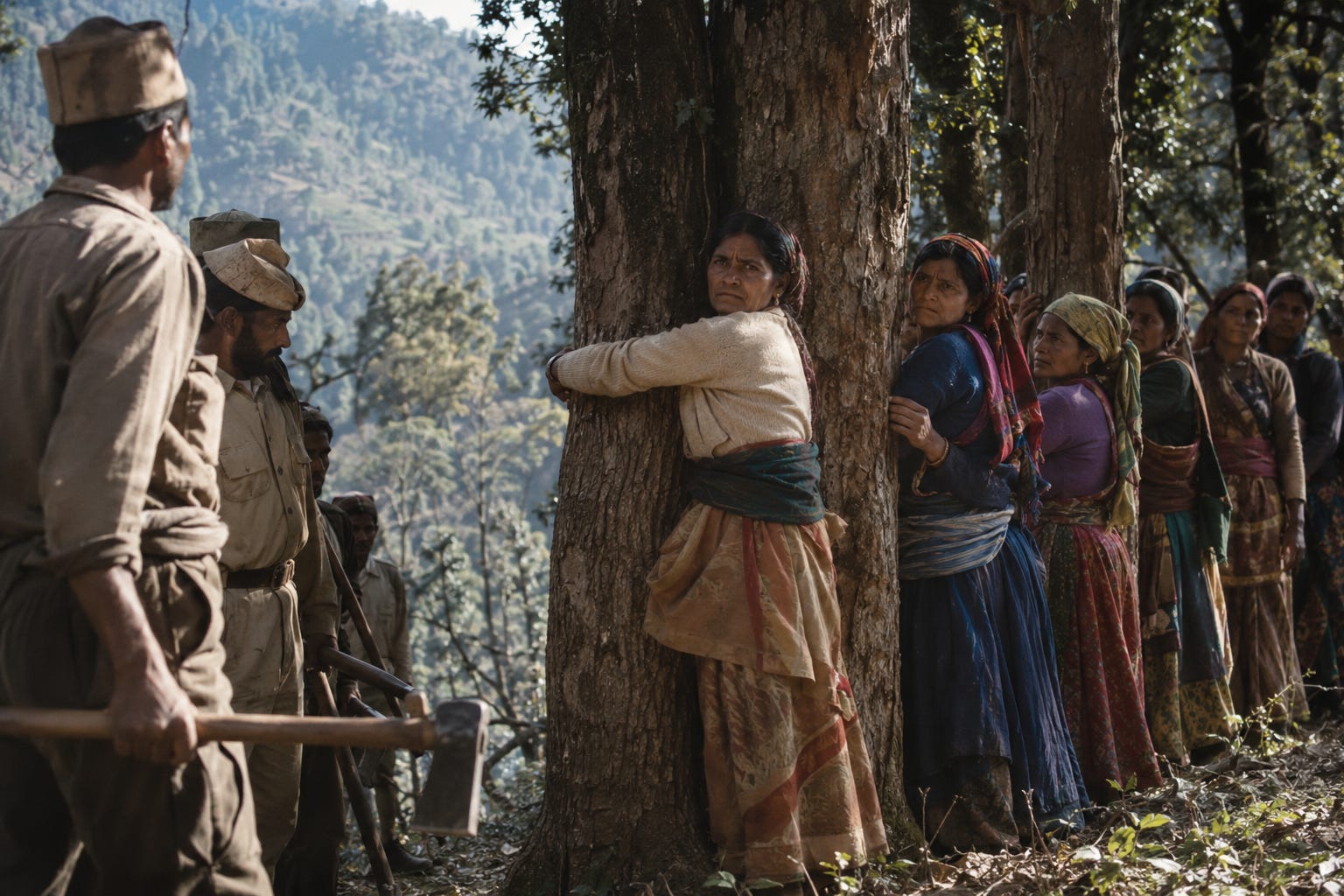
Imagine that confrontation. Men with axes, backed by a commercial contract, facing village women who had absolutely none of the power normally required to stop them.
And yet, the men couldn’t proceed.
The standoff lasted through the night. Eventually, the loggers withdrew.
The trees remained standing.
The movement that changed the conversation.
The confrontation became one of the defining moments of the Chipko movement. Chipko means to cling or embrace, and the movement had already begun spreading across the Garhwal Himalayas.
Its argument was beautifully simple: why should outside contractors profit from forests while the communities living beside them struggled to access the same resources?
Activists including Chandi Prasad Bhatt and Sunderlal Bahuguna helped carry that question across the region and eventually into India’s political consciousness.
In 1980, India enacted the Forest (Conservation) Act, strengthening central oversight of forest-land diversion. Around the same period, Indira Gandhi’s government imposed a 15-year restriction on green felling in Himalayan forests of Uttar Pradesh above 1,000 metres, subject to exceptions.
Chipko was one important influence on this shift, not the sole reason for it.
Still, think about what had happened.
Women who had set out to protect a few trees helped push an entire country to reconsider how its forests should be treated.
But here’s the extraordinary part.
It had happened before.
The woman who did it first.
Travel back 244 years, to 1730, in the Rajasthan village of Khejarli.
A royal party arrived to cut khejri trees for construction work associated with the Maharaja of Jodhpur.
A Bishnoi woman named Amrita Devi refused to let them.
According to the community’s historical account, she embraced a tree and was killed while protecting it. Others followed her example. By the time the violence ended, 363 Bishnois were said to have sacrificed their lives defending the trees.

The Maharaja subsequently ordered protections for trees and wildlife in Bishnoi villages.
Two women. Two different centuries. Two different landscapes.
And the same conviction that some things are worth more than the money someone can make by destroying them.
But there’s something uncomfortable about celebrating these victories.
Saving the forest doesn’t always save the village.
Chipko succeeded in bringing forest protection into the national conversation. But many of its demands for local livelihoods and community economic rights remained unresolved.
The forest could survive while the people who protected it continued struggling.
And that’s something I keep coming back to in my own work.
I’ve spent years in waste management and recycling, watching companies celebrate landfill diversion, carbon reductions, and circular economy commitments.
But the people collecting, sorting, and recovering those materials often remain the least visible part of the story.
We want cleaner cities. But are we creating better livelihoods for the people cleaning them?
We want forests protected. But do we want the communities protecting them to prosper?
An environmental victory that leaves people behind is only half a victory.
Fifty-two years later.
Today, we have satellites that monitor deforestation, artificial intelligence that tracks ecosystems, carbon markets, environmental legislation, and sustainability reports thick enough to stop a door.
In 1974, Gaura Devi had none of that.
She had 26 other women, a forest, and a decision to make. She could step aside and watch the trees fall, or she could stand her ground.
She chose the forest.
And that’s the part I find impossible to forget.
Because somewhere along the way, we’ve made environmental action sound impossibly complicated, as though meaningful change must always begin with a billion-dollar investment, a government committee, or an international agreement.
Of course, we need all the science, technology, policy, and investment we can get.
But sometimes change begins with something much simpler.
Someone deciding that enough is enough.
On March 26, 1974, a logging crew arrived in Reni expecting to cut down a forest.
Instead, they met 27 women who refused to move.
The trees remained. And India remembered.
_____________________________________
Elsewhere in the circular economy
India is manufacturing solar panels at an astonishing pace. The country reportedly added 50.6 GW of solar module manufacturing capacity in the first half of 2026, pushing its cumulative capacity beyond 261 GW. But rapid expansion brings a new challenge: finding markets for all those panels, particularly as trade restrictions complicate exports. Manufacturing capacity is impressive. Sustainable demand is what makes it valuable.
The next big battery-recycling battle may be fought before a single battery reaches a recycling plant. NavPrakriti is targeting partnerships with more than 150 battery manufacturers and EV companies as India’s battery market expands. The lesson? In recycling, whoever builds reliable collection and supply relationships early could have a substantial advantage.
Chennai is preparing to turn seawater into drinking water at an enormous scale. A new 400-million-litre-per-day desalination plant is under development to serve the city’s growing water needs. It could become an important part of Chennai’s water security, although energy use, operating costs, and brine management will remain important considerations.
Carbon emissions are becoming a balance-sheet conversation. Around 490 Indian companies across nine sectors are reportedly entering a new phase of compliance under India’s Carbon Credit Trading Scheme. The important shift isn’t just that companies must measure emissions. It’s that failure to meet applicable obligations can now carry direct financial consequences.
India’s electric car market is growing faster than many expected. Between January and August 2026, reported sales of electric cars and SUVs reached 215,871 units, a 79% increase year on year. More electric vehicles mean growing opportunities in charging infrastructure, battery servicing, second-life applications, and eventually recycling.
And in Varanasi, a different kind of environmental action made a difference. Following recent floods, Namami Gange volunteers reportedly removed more than a tonne of waste from Dashashwamedh Ghat in a single cleanup drive.
No elaborate technology. No complicated business model. Just people showing up and doing the work.
Which, when you think about it, is exactly where our story began.