


Most ocean surveys go looking for something specific. A fish stock to count, a reef to map, a pipeline route to clear. The Mar del Plata Submarine Canyon expedition, led by Dr. Daniel Lauretta at Argentina’s Museo Argentino de Ciencias Naturales “Bernardino Rivadavia,” wasn’t chasing one thing. It was a baseline survey — the kind of trip where the honest goal is just “let’s see what’s actually down there,” in a stretch of the southwestern Atlantic shelf that had never been looked at closely before.
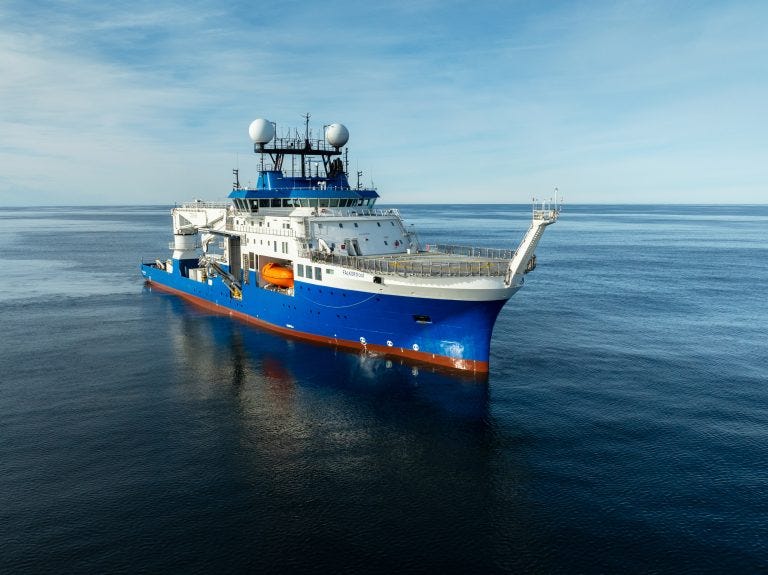
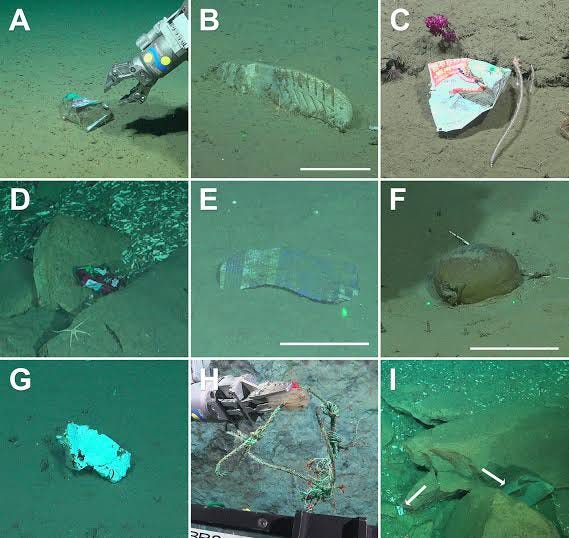
What came back, across 17 submersible dives during the 2025 summer season, was two stories stacked on top of each other. The first: on 10 of those 17 dives, the team logged 29 pieces of unmistakably human debris — plastic wrappers, shopping bags, food packaging, fishing gear, a rubber boot — sitting on the seafloor at depths between 1,920 and 3,814 meters. Almost four kilometers down, in a place no fishing boat or beachgoer has ever directly touched. The second story, found in the same footage, on the same dives: roughly 40 species that may be entirely new to science.
Nearly four kilometers down is not supposed to be easy to reach
It’s worth sitting with the depth for a second, because it’s the whole reason this canyon is interesting instead of another routine ocean survey. Mar del Plata Canyon carves into the continental shelf off Argentina’s coast, and its deepest surveyed points here — 3,814 meters — put it well below where sunlight penetrates, past the mesophotic zone entirely, into genuine deep-sea territory. Getting a research team, a submersible, and camera equipment down there and back isn’t cheap or quick. It’s exactly the kind of place that stays unsurveyed for decades simply because nobody has the budget or the equipment lined up at the right time — the same story that let a living coral reef off Benin go unrecorded for sixty years, as this digest covered a few weeks back.
That’s what makes the trash finding land differently than a beach cleanup number. Nobody drove a boat out to this canyon and dumped a bag of wrappers over the side. The debris that Lauretta’s team found had to travel there — carried by currents, sinking slowly from the surface or drifting in from fishing activity, settling into a canyon that, according to the survey, holds noticeably more litter than the open seafloor around it. The canyon’s own shape, the same geological feature that makes it worth studying, appears to be funneling debris in exactly the way a drain funnels water. Depth was never a defense. It just delayed the discovery of how little defense there actually was.
The part that should unsettle you more than the trash count
Here’s the detail from the survey that’s harder to sit with than “29 objects.” Some of the debris wasn’t just resting on the seafloor — it had things growing on it. Deep-sea corals and starfish had attached themselves directly to pieces of plastic, using it the way they’d use any other hard surface on an otherwise soft, sediment-covered seabed.
It would be easy to read that as a hopeful detail — nature adapting, life finding a way, the ocean shrugging off what we throw at it. Lauretta’s team was careful not to let that reading stand unchallenged. Colonizing a piece of plastic is not the same as thriving on it. A barnacle or a coral polyp attaching to a bottle because it’s the only solid surface within reach isn’t evidence the ecosystem is fine with plastic in its habitat — it’s evidence of how sparse hard surfaces naturally are on a soft seafloor, and how readily deep-sea organisms will use whatever shows up, including garbage. What looks like resilience at a glance is really just opportunism under scarcity, and conflating the two is exactly how people end up telling themselves plastic pollution in the deep ocean is a manageable, even mildly interesting, side effect rather than a genuine problem.
Forty unnamed species, found by accident
The other half of this expedition is the part that would normally be the entire headline on its own: around 40 species that may be new to science, documented across those same 17 dives. Deep-sea biodiversity surveys routinely turn up new species — the deep ocean remains the least-catalogued major habitat on the planet, full stop — but finding that many candidates in one canyon, on what was fundamentally a baseline reconnaissance trip rather than a dedicated taxonomic expedition, says something about how little of this specific stretch of ocean anyone had actually looked at before.
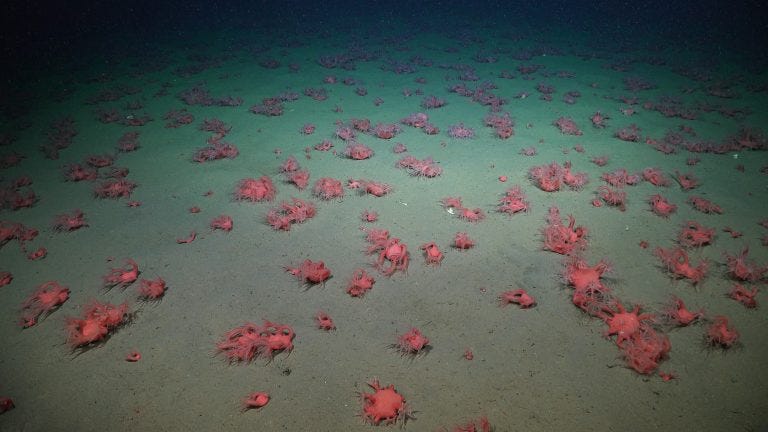
That’s the real headline underneath both findings, trash and new species alike: this canyon was, functionally, unmeasured. Not protected, not studied, not on anyone’s map as either a conservation priority or a pollution concern, simply because nobody had gone and looked. The expedition didn’t discover that the canyon suddenly became interesting. It discovered that it always was, and that “we don’t have data on this yet” is doing a lot of quiet, unexamined work across the ocean generally — the same blind spot that let old, out-of-date verdicts about supposedly dead or empty places sit unchallenged for decades.
Why a circularity newsletter keeps writing about the ocean
The pattern connecting this to everything else in this digest isn’t subtle once you see it: an unmeasured space defaults to being treated as either empty or fine, and it’s neither, until someone actually goes and checks. A canyon nobody surveyed becomes a canyon nobody protects and nobody worries about polluting — right up until a research team spends the money to go look, and both problems and discoveries turn out to have been sitting there the whole time, undocumented rather than nonexistent. Waste streams get the same treatment constantly. A byproduct nobody’s measured doesn’t get called “waste” or “resource” — it just doesn’t get called anything, and defaults to the drain, the landfill, or the ocean floor, purely because pricing or protecting it would first require someone to count it.
Mar del Plata Canyon isn’t a circularity story in the tight sense — nothing here is getting looped back into a supply chain. But it’s a clean illustration of the same failure mode this newsletter tracks in landfills and MRFs and EPR policy every day: distance and depth get mistaken for safety, and the absence of data gets mistaken for the absence of a problem. Both mistakes run in both directions. The trash traveled nearly four kilometers to get there. So, unnoticed, did an entire community of species nobody had catalogued yet.
What to watch next
The honest caveat is the one that applies to essentially every single-expedition finding: 40 “possible new species” is a preliminary count, not a confirmed one — formal taxonomic description takes years, sample-by-sample, and some fraction of these will turn out to already have names once they’re compared against existing collections. Similarly, 29 objects across 10 dives establishes that debris reaches this depth and concentrates in this canyon; it doesn’t yet establish the total volume down there, or how it compares to other unsurveyed canyons along the same coastline.
The number worth tracking over the next couple of years isn’t the species count or the object count from this one trip. It’s whether Argentina, or a regional research consortium, goes back to survey the rest of that canyon system, and whether “we should probably check the other unsurveyed canyons nearby” becomes a funded follow-up rather than a line in a paper’s discussion section. A canyon that sat unmeasured for this long has already demonstrated what happens by default. What hasn’t been tested is what happens once someone decides to keep looking.
Quick Hits — everything else from today’s digest
Waste & Circularity
Delhi’s first compressed biogas plant is coming online at Goyla Dairy, processing 200 tonnes of cattle dung daily into vehicle fuel and organic fertilizer. Funded through the Union Housing Ministry’s Urban Development Fund and folded into the “Clean Yamuna” initiative, which is ultimately targeting 1,500 tonnes of dairy waste. Source
Energy Transition
Maruti Suzuki switched on a 300 kW green-hydrogen electrolyzer at its Manesar plant, using surplus solar power to make hydrogen blended straight into the factory’s natural-gas fuel line — part of a plan to cut manufacturing emissions from roughly 615,000 to 266,000 tonnes by FY2030-31. Source
Climate & Biodiversity
Mixed-species forests recover faster from climate extremes than monocultures do. A Peking University-led study of 88,116 US forest plots from 2001-2020 found tree diversity buffers against compound heat-and-drought or heat-and-flood events, holding across 22 different ecoregions regardless of soil type or climate zone. Source
Materials, Packaging & Building
Climeworks’ direct air capture plant in Iceland got six times more effective in a single year. Mammoth pulled 675 tons of CO2 from the air in the first half of 2026, versus roughly a sixth of that a year earlier, while operating costs fell more than 50% — no new hardware, just better filters and tighter operations. Source
Mobility & EVs
Thirty more electric buses rolled out in Gandhinagar this week, 210 kWh battery packs with 200+ km range, taking the city to 70 of a planned 100 units under India’s PM e-Bus Sewa scheme — part of a national push toward roughly 24,000 electric buses across smaller cities and metros combined. Source
India crossed 10 million cumulative EV sales since 2017, with penetration now at 11% — nine million of those ten million sold in just the last five years, and 2026 is on pace for a record 3.5 million EVs sold in a single year. Source
Agriculture & Food Systems
India loses an estimated $18.5 billion in food every year to post-harvest gaps, according to a new ASSOCHAM-ASCELA report released at Delhi’s Cold Chain and Warehousing Summit — against 358 million tonnes of grain and 371 million tonnes of horticulture produced annually. The report’s real argument: the fix isn’t more cold storage capacity, it’s connectivity and standardization between farmer, storage, and buyer. Source
Cleanups & Social Good
The Municipal Corporation of Delhi cleared 18,495 tonnes of waste from land beside railway tracks — 49.74 km of track across 123 locations, worst in Karol Bagh, Keshavpuram, and the City SP zone — quiet illegal dumping that had built up for years before anyone measured it. Source
Deep Dive
Rome was recycling glass before “recycling” was a word. Roman glassmakers melted down broken glass into new vessels around 500 BCE; Mesopotamian metalworkers recycled scrap bronze by 2400 BCE; Japan’s imperial court formally ordered used-paper recycling in 1031 CE. None of them called it sustainability — they called it not wasting something expensive to make from scratch. Source
This is the feature + roundup edition of the Circularity Digest, built by the research team of Cercle X, headed by Vishnu Vardhaan.
Loved reading this? Share it with your friends and your peers, and colleagues. Let’s build a wave of circularity across the world.