


Chennai wants its residents to separate their waste.
The system has to keep its side of the bargain.
You wash the milk packet.
Keep the cardboard dry.
Explain to everyone at home why the food waste goes in a different bin.
Then you watch the collection worker empty everything into the same pile.
Tomorrow morning, how carefully will you sort?
That question sits at the heart of Chennai’s four-bin push.
The city collects around 6,150 tonnes of garbage every day.
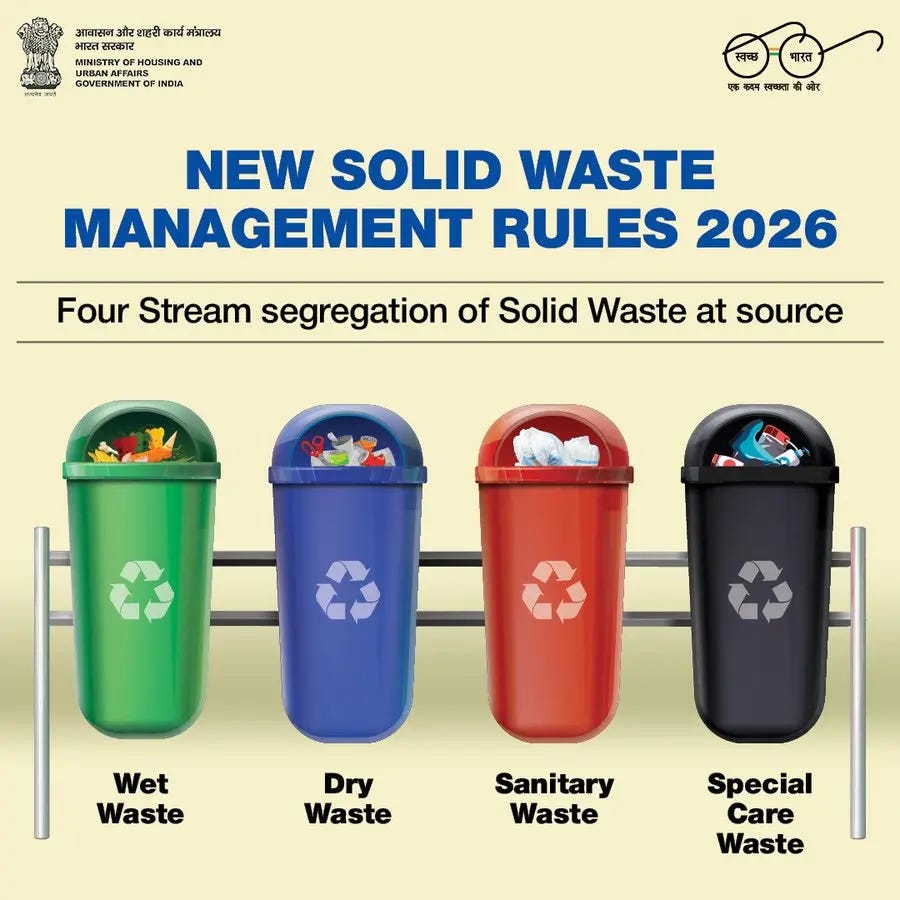
Its segregation directive asks waste generators to separate that waste into four streams:
Green for wet waste.
Blue for dry recyclables.
Red for separately wrapped sanitary waste.
Black for domestic hazardous or special-care waste.
Collection vehicles have been provided with colour-coded bins too.
Violations can attract penalties.
Good.
Now comes the difficult part: making sure nobody’s effort gets undone halfway down the road.
I work in waste.
And the question I keep coming back to is painfully basic:
What happens at the next handover?
Because waste changes hands.
From the kitchen to the housekeeping team.
From the building to the collector.
From the collection vehicle to a transfer point.
From there to a facility.
Every handover is a chance to preserve the separation.
Or erase it.
One careless unloading can undo an entire street’s morning.
And it does something worse than mixing materials.
It gives people a perfectly reasonable excuse to stop.
Why should I bother? They mix it anyway.
Once that sentence enters an apartment WhatsApp group, your next awareness campaign has a much harder job.
You’re asking people to trust you again.
From the cluster audits we’ve run, three weak points keep coming up.
The household that gives up.
Week one is enthusiasm.
New bins.
New instructions.
Everyone is participating.
By week three, somebody has a question nobody answers.
A collection gets missed.
The person who usually handles the waste is away.
The system needs to work on that morning too.
The vehicle that undoes the work.
Separate compartments help.
But what happens when they fill up?
When the usual vehicle breaks down?
When the load reaches the transfer point?
The backup arrangement matters as much as the launch-day arrangement.
The black bin nobody understands.
An old battery.
A broken bulb.
Expired tablets.
We’ve told people where to put them.
Have we told the worker how to handle them?
Who collects them next?
Where they are supposed to go?
A black bin is a promise that somebody has answered those questions.
We should check.
Chennai’s collection instructions cover all 200 wards.
That means thousands of ordinary decisions, made under pressure, every morning.
The conservancy worker at your gate is where all those decisions meet.
That person needs training, equipment, time and a route that actually supports segregation. Asking them to fix every household’s mistake while keeping collection on schedule is a convenient way to pass the problem down.
So yes, inspect the bins.
Then follow the waste.
Check the collection vehicle.
Watch the unloading.
Verify the destination.
Find out whether the facility received separate material or somebody else’s mixed problem.
The resident’s responsibility starts at the bin.
The city’s responsibility continues after it.
Both have to hold.
Otherwise, we’ll buy four bins, print four stickers, collect a few fines and wonder why the same mountain keeps growing.