



490 industrial units.
Seven sectors.
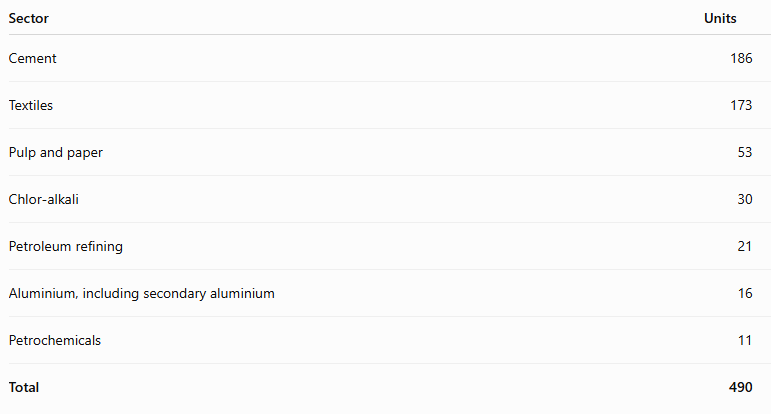
The government’s January announcement put the coverage at 490 obligated industrial units across seven sectors.
That does not mean 490 separate companies.
A company operating several notified plants can appear several times, because the obligation sits with the listed unit.
And the composition is interesting.
Cement accounts for 186 units.
Textiles account for 173.
Together, they make up roughly 73% of the list.
The remaining units are in pulp and paper, chlor-alkali, petroleum refining, aluminium and petrochemicals.
For those of us working with factories in Tamil Nadu, that makes this a much more immediate story than the phrase “carbon market” suggests.
The official portal is indiancarbonmarket.gov.in, launched on March 21, 2026. It is the government’s platform for administering the market. However, a functioning portal does not establish that trading has opened: October 21 reporting still described verification as underway, with credit issuance to follow.
The basic transaction is straightforward.
A factory that performs better than its notified emissions-intensity target can earn certificates to sell.
A factory that falls short must purchase and surrender certificates to cover the gap.
But how much improvement are these factories actually being asked to deliver?
Take UltraTech’s Reddipalayam unit.
The compiled schedule lists its baseline intensity at 0.5507 tonnes of carbon-dioxide equivalent per tonne of equivalent product, with a 2026–27 target of 0.5363.
That is a reduction of about 2.61%.
Tamil Nadu Cements Corporation’s Ariyalur unit has a baseline of 0.4797 and a target of 0.4689, about 2.25% lower.
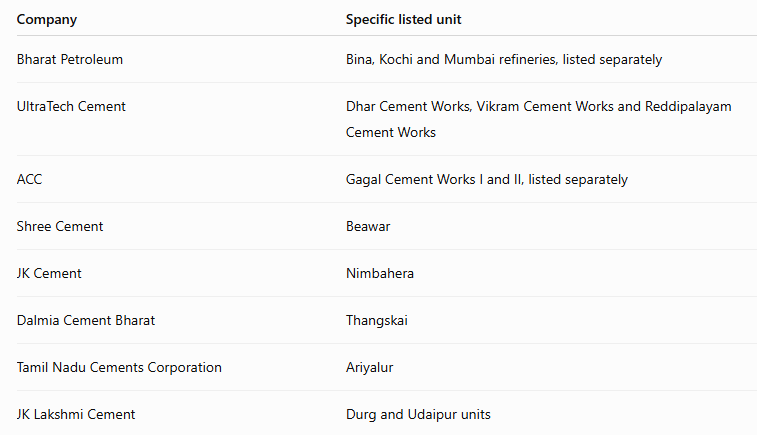
Those numbers give us a much better question than whether carbon trading is good or bad.
What would it take for each plant to achieve that improvement?
An equipment replacement already planned?
Better fuel management?
A substantial investment that would otherwise never get approved?
The schedule tells us the required improvement.
It does not, by itself, tell us how much of that improvement would have happened anyway.
There is another detail hiding in the unit of measurement:
emissions per tonne of product.
Suppose a factory starts at one tonne of emissions per tonne produced.
Its target is 0.95.
It achieves 0.90, but increases production from 100,000 tonnes to 150,000 tonnes. Total emissions rise from 100,000 to 135,000 tonnes.
The factory has beaten its target.
Its emissions have also increased by 35%.
Under an intensity-based scheme, those outcomes can coexist.
Credits are calculated using the difference between the target and achieved intensity, multiplied by production.
They reward performance against that benchmark, rather than automatically proving a fall in the factory’s total emissions.
That is a deliberate way to accommodate industrial growth.
But it means anyone reading a company’s carbon-credit announcement should ask what happened to both numbers: emissions per tonne and total emissions.
Then comes the evidence.
Who verifies the fuel consumed, the production reported and the resulting emissions calculation?
BEE publishes a register of accredited verification agencies, including their sector scopes and accreditation status.
Its compliance procedure requires documented verification and an independent technical review by someone outside the verification team.
There is a checking framework.
The question is how rigorously it operates.
Working in waste management, I find that familiar.
With an EPR certificate, I want to trace the document back to the material: what arrived, where it was processed and which records connect the two.
With carbon credits, I want to trace the certificate back to the factory’s measured performance, then understand whether the benchmark demanded a meaningful change.
A trading price will eventually tell us what a certificate costs.
The factory records will tell us what it represents.
That is the proposition behind India’s Carbon Credit Trading Scheme.