


If you walk south of the Colosseum in Rome today, past the Pyramid of Cestius and into the neighborhood locals still call Testaccio, you’ll find a hill. It’s not a big hill by Roman standards — 35 meters, maybe less than what it once was — but it’s steep enough that people build restaurants and wine bars directly into its slope, cutting doorways into what looks, from a distance, like ordinary rock.
It isn’t rock. It’s trash. Specifically, it’s somewhere around 53 million broken clay jars, stacked, sorted, and compacted by hand over roughly three centuries, starting around the 1st century BC. The Romans called the general practice testae — broken pottery — and this particular pile got big enough to earn its own name: Monte Testaccio. The mountain of shards.
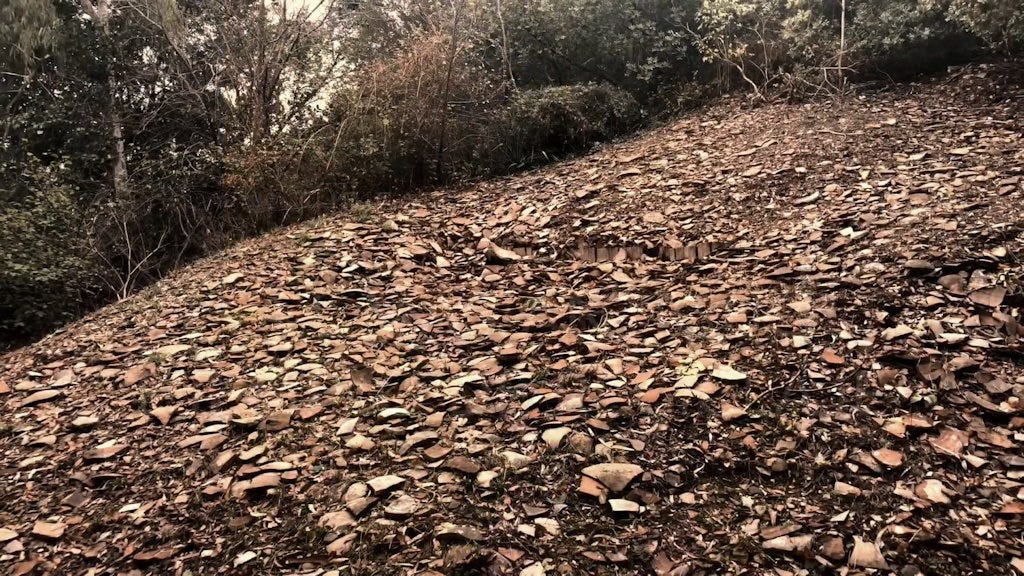
I’ve spent a lot of this year writing about circularity as something new — AI sorters, carbon-cured bricks, enzymes that eat plastic. Monte Testaccio is a useful gut-check, because it’s a 2,000-year-old reminder that “what do we do with the stuff we can’t recycle” is not a new question. Rome had an answer. It just wasn’t the answer you’d expect.
The oil economy that built a mountain
Start with why the jars existed at all. Rome, at its peak, was a city of over a million people with essentially no local olive oil production worth mentioning. All of it came in by ship — mostly from Baetica, the Roman province roughly overlapping today’s Andalusia in southern Spain — packed into a specific style of amphora known to archaeologists as the Dressel 20. Fat-bodied, thick-walled, built to survive a sea crossing without leaking.
The numbers involved are hard to hold in your head. Based on the volume of material in the mound, historians estimate Rome was importing at least 7.5 million liters of olive oil a year, for centuries, just to keep the city running — cooking, lighting lamps, bathing. Each liter meant a jar. Each jar, once emptied, became a problem.
And here’s the part that makes Monte Testaccio interesting instead of just old: Rome recycled constantly. Wine amphorae and grain amphorae, once empty, routinely got smashed up and mixed into concrete as aggregate, or reused whole as drainage pipes, plumbing casings, even burial urns for infants. Reuse-of-broken-pottery is such a well-documented Roman habit that archaeologists have a name for the study of it. The Dressel 20, though, wouldn’t cooperate. Its walls were too thick to break down into anything useful, and — this is the detail that gets me — the walls were saturated with residual olive oil that had gone rancid over the voyage. That oil reacted chemically with the lime in concrete mix and ruined it. You couldn’t grind the jar up. You couldn’t build with it. You couldn’t even burn it cleanly, because Rome didn’t want the entire dock district smelling like burning spoiled oil for a decade.
So the material that arrived in the highest volume, that the city needed the most, was also the one piece of packaging Rome had no circular use for at all.
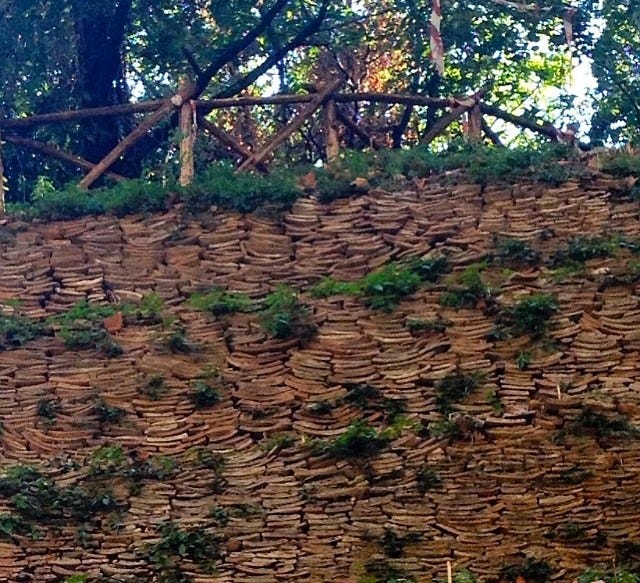
What they did instead: they engineered the failure
This is the detail I think gets lost when this story gets told as “ancient people also had a trash problem, ha ha.” Monte Testaccio was not a dump in the way we picture one — not a heap where people flung jars over their shoulder and walked away. Archaeological surveys have found it’s terraced. Retaining walls built from larger jar fragments hold back the smaller broken material behind them, in organized tiers, rising as the mound grew. Access ramps allowed workers to keep hauling material up to the working face at the top, layer after layer, year after year. At the campaign’s peak in the 2nd century AD, researchers estimate as many as 130,000 amphorae a year were being deposited there — over 350 jars a day, every day, methodically stacked rather than dumped.
This was, by most reconstructions, managed by the praefectus annonae — the Roman official in charge of the city’s food supply. In other words: waste management for unrecyclable oil jars wasn’t an afterthought bolted onto Rome’s food distribution system. It was part of the food distribution system. The empire that gets credit for inventing aqueducts and concrete and standardized road networks looked at a packaging material it flatly could not close the loop on, and instead of pretending otherwise, built dedicated, state-run infrastructure to contain the failure as productively as possible.
Sprinkle lime between the layers to control the smell and stabilize the pile as it went, and 300 years later, you get a mountain stable enough to still be standing in 2026, with wine bars carved into it.
Why I think this matters for anyone doing circularity work right now
Every circularity program I’ve ever been part of eventually runs into its own Dressel 20 — the fraction of material that arrives at real volume, that everyone agrees is a problem, and that genuinely cannot be closed-looped with the technology or economics available right now. Multi-layer flexible plastic. Certain composite textiles. In our world, contaminated mixed waste streams that no MRF sorter, however good the optical scanner, can pull apart economically.
The instinct in a lot of sustainability messaging is to treat that fraction as an embarrassment — the thing you don’t put in the annual report, the stat you’d rather round away. Monte Testaccio suggests a different posture. Rome didn’t hide its unrecyclable fraction. It didn’t pretend the Dressel 20 problem didn’t exist, or promise investors a breakthrough was six months away. It built dedicated, visible, engineered infrastructure to handle the stuff honestly — and in doing so, accidentally created one of the best-preserved economic records of the ancient world. Archaeologists can now read Roman trade volumes, shipping routes, and even individual producer stamps directly off the broken jars, because someone bothered to organize the failure instead of scattering it.
“Zero waste” gets used today like it’s a real, reachable state. It isn’t, and it never has been, for any economy at any point in history — Rome included. What’s reachable is being honest and organized about the fraction you haven’t solved yet, instead of letting it become an unmanaged mess. Rome built a landmark out of that honesty. Most of us are still working on the honesty part.
Quick Hits — everything else from today’s digest
Waste & Circularity
India recognized 42,000+ informal waste workers as “climate champions.” Project Utthaan, backed by the UNDP, now gives them bank accounts, insurance, e-Shram IDs, free LPG cylinders, and Ayushman health coverage — the infrastructure of a stable life, not just a job title. Source
India’s new Solid Waste Management Rules mandate four-stream segregation at the source — wet, dry, sanitary, and special care. Any bulk generator (20,000+ sq.m, or 100+ kg of waste a day) must now compost on-site or hold a formal certificate proving someone else does, legally. Source
UT Austin and Sandia National Labs found the first real recycling path for pDCPD — the tough plastic in vehicle bumpers and chemical storage tanks that’s currently only fit for incineration. A ruthenium-catalyzed solvent bath deconstructs it into reusable powder over hours to days. Source
Energy Transition
India’s battery storage additions jumped 84x year-over-year — 8.2 GWh added in H1 2026 versus just 98.4 MWh in the same window last year, with GAIL, Bihar’s state power company, and NTPC’s sodium-ion pilots all in motion. Source
Water & Ocean Systems
The Ocean Cleanup is deploying interceptor barriers across two Mumbai creeks — Trombay and Malad — that together carry an estimated 5 million kilograms of plastic into the Arabian Sea every year. Early systems are projected to recover 61-92 tonnes annually. Source
Climate & Biodiversity
Europe’s summer heat and drought cut soybean yields 15% below the five-year average, with maize maturing three weeks early across Spain, France, Italy, Greece, Croatia, and Hungary. In the worst-hit areas, harvesting some fields stopped being economically worth doing at all. Source
Materials, Packaging & Building
The Magical Mushroom Company raised £3 million to scale mycelium packaging to industrial production — it fully biodegrades in about 45 days in a home garden bin, no industrial composter required. Source
A Calgary startup called CURA raised $10 million to replace cement’s dirtiest step with electricity instead of fire. Cement production is roughly 8% of global emissions; CURA’s electrochemical process claims up to an 85% cut. Source
Policy, Finance & Carbon Markets
The carbon credit market is projected to grow nearly 7x by 2033 — from $886.8 billion in 2025 toward $6.13 trillion — though compliance markets, led by Europe’s Emissions Trading System, still own over 98% of that revenue. Source
Cleanups & Social Good
Varanasi pulled over a tonne of garbage out of the Ganga at a single ghat after recent floods pushed silt and debris into the river, with the Namami Gange cleanup timed to Pitru Paksha’s shramdaan (voluntary service) traditions. Source
This is the feature + roundup edition of the Circularity Digest, built by the research team of Cercle X, headed by Vishnu Vardhaan.
Loved reading this? Share it with your friends and your peers, and colleagues. Let’s build a wave of circularity across the world.