


Somewhere in Gurugram, a 21-year-old parked a JCB next to a drain nobody had touched in years, climbed down into the filth himself, and started filming. He didn’t wait for a permit or a press release. He just went in.
By the time he climbed back out, his crew had pulled 2,435 kilograms of trash from a single stretch near Khedki Daula, plastic and silt and years of nobody’s problem, all of it finally somebody’s problem.
He posted the video that same evening, grime still on his hands.
Two days later, 1.9 million people had watched him do it.
And before the comments even settled, he was already telling them where he’d be next.
Watch the footage and you’ll feel it too: that strange mix of admiration and discomfort, because somewhere underneath the awe is a quieter, less flattering question.
If one guy with a JCB can do this in days, why has this drain been sitting there for years?
That’s Surendra Singh Choudhary, known online as Bittu Tabahi, “the River Rebel.”
He’s become the most interesting waste-management story in India this month, and it has almost nothing to do with technology. It has everything to do with a question this industry keeps avoiding: who is actually supposed to fix this?
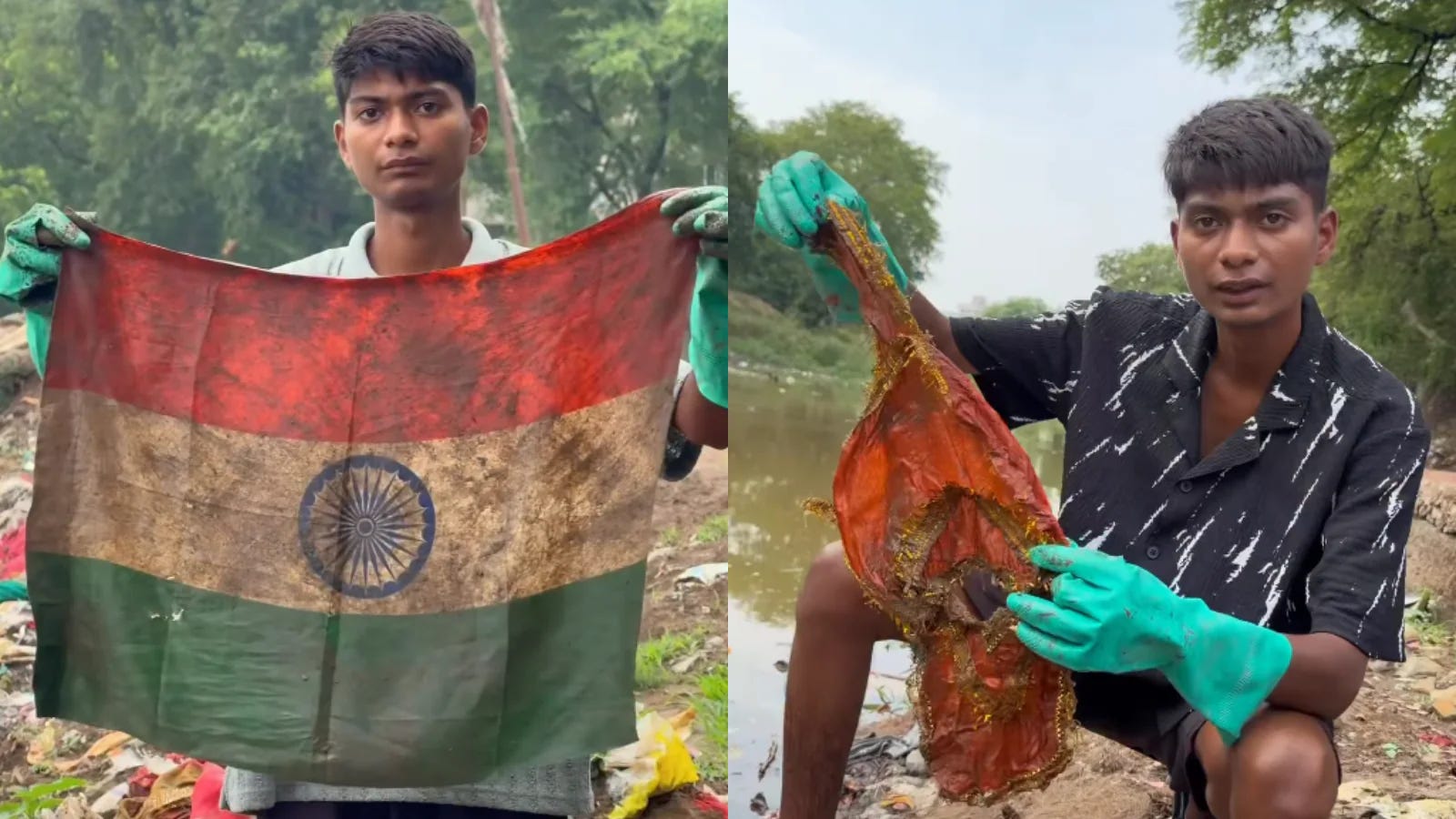
From one river, alone, to a movement with a hashtag
Choudhary’s story doesn’t start in Delhi.
It starts in his home state of Madhya Pradesh, on the Ajnar River, where he showed up alone with basic tools and started clearing years of accumulated waste out of the water — no NGO backing, no government order, no camera crew.
Just him, the river, and a phone propped up on something.
He posted the footage the way anyone posts anything now: raw, unedited, with no real plan for what would happen next.
What happened next was that it worked. The Ajnar cleanup went properly viral, and Choudhary did the thing almost nobody manages to do with a viral moment — he turned it into a system instead of a memory.
He didn’t disappear after the algorithm moved on.
He picked a bigger, harder target: the Yamuna, the river that Delhi’s government has spent years and enormous sums trying to clean through official channels, with famously mixed results.
On September 20 — World Cleanup Day — Choudhary launched a coordinated campaign across Delhi-NCR under the hashtag #CleanWithBittu.
His crew pulled roughly 585 kilograms off the Yamuna riverbank.
Then they moved to Gurugram, brought in heavier equipment, and cleared 2,435 kilograms near Khedki Daula in a matter of days.
Noida is next; Choudhary announced it the way a musician announces a tour date, not the way a cleanup crew files a work order:
“Milte hain Noida mein” — see you in Noida.
The part that should make policymakers uncomfortable
It would be easy to file this under “inspiring young person does good deed” and move on, but the more interesting story is what it reveals about the gap between official capacity and actual results.
Delhi’s municipal bodies have run large, well-funded, multi-year river and drain cleanup programs.
Those programs exist, they have budgets, and they have produced real tonnage numbers of their own — Delhi’s MCD cleared 18,495 tonnes of waste from land along its railway tracks earlier this month, a genuinely large operation covering 123 locations across the city.
But a 21-year-old with a JCB, a camera, and no institutional backing found a stretch of Gurugram nobody had prioritized, and cleared it himself, on a timeline measured in days rather than years.
That’s not a knock on the people running the official programs — 18,495 tonnes of accumulated illegal dumping doesn’t get identified or measured without some kind of institutional effort behind it.
It’s a different point: the two approaches are complementary, and the informal one moves at a speed and with a visibility that institutional cleanups structurally can’t match. An MCD drive gets a press release.
Bittu Tabahi gets 1.9 million people watching him do the actual work, in real time, and then showing up to help.
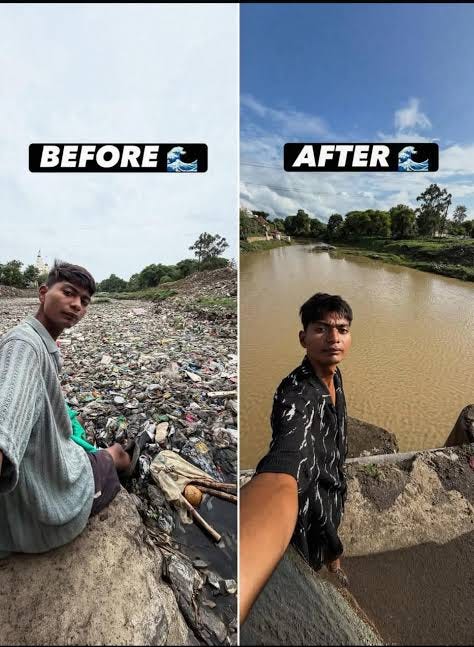
That distinction is exactly why Boyan Slat’s organization, The Ocean Cleanup — the outfit that’s spent a decade building industrial-scale river and ocean plastic interceptors — has reportedly reached out to Choudhary with a job offer.
The Ocean Cleanup’s whole model is engineering solutions deployed with institutional rigor and long time horizons.
What it doesn’t have, and what Choudhary has in abundance, is the ability to make millions of people care about a specific drain in Gurugram on a Tuesday.
Put those two things in the same organization and you get something neither has on its own.
Why a circularity newsletter is writing about a guy with a JCB
It’s tempting to treat this as a feel-good aside from the “real” circular economy stories — the EPR policy shifts, the material innovations, the carbon accounting.
But the Bittu Tabahi story is actually a circularity story in the most literal sense: waste that had been treated as permanently out of the loop — dumped, buried, forgotten — got physically pulled back into a system where it can at least be sorted, processed, or kept from re-entering the water.
The mechanism matters less here than the pattern that keeps showing up across every domain this digest covers, from carbon-capturing bricks to soil-carbon farm payments: value or harm that everyone had implicitly priced at zero — an ignored drain, a “worthless” byproduct, an unmeasured emission — turns out to be worth something the moment somebody actually looks at it and does the work.
The honest caveat is the same one that applies to every volunteer cleanup effort: pulling 2,435 kilograms of trash out of one drain doesn’t fix the systemic reasons that trash ended up there in the first place — inadequate collection infrastructure, weak enforcement against dumping, and drainage systems that were never designed with today’s waste volumes in mind.
Choudhary’s videos don’t claim otherwise; if anything, the recurring, methodical nature of the campaign — river after river, city after city — is itself an argument that this is a symptom needing a systemic fix, not a one-time miracle.
What’s worth actually tracking over the next few months is whether #CleanWithBittu becomes a genuine model — a repeatable, community-mobilized complement to institutional cleanup programs — or whether it, like most viral environmental moments, quietly fades once the novelty wears off.
The signal to watch isn’t the follower count.
It’s whether the volunteers who show up in Noida are still showing up three cities and three months from now.
Quick Hits — everything else from today’s digest
Water & Ocean Systems
A desalination process that leaves behind solid salt instead of toxic brine — and recovers roughly half the lithium hidden in the water along the way. University of Rochester engineers built laser-etched black metal panels aimed at the 2.2 billion people worldwide without safely managed drinking water. Source
Materials, Packaging & Building
An engineering college in Tamil Nadu built a concrete that eats carbon dioxide. Swapping half the sand for zeolite and 1% of the cement for bamboo biochar produces “ZB5” — 15% stronger in tension than regular concrete, and it actively absorbs CO2 from the air around it. Source
Waste & Circularity
India holds roughly 35% of the world’s ship-recycling market, re-rolling scrapped-vessel steel straight back into construction supply chains at 58% less carbon than virgin steel — though the recycled steel still trades at a discount because no formal certification standard exists yet. Source
Mobility & EVs
India sold a record 327,901 EVs in July 2026, up 66% year-on-year — but its 52,718 public charging stations remain concentrated in a handful of cities, leaving the ownership math difficult everywhere else. Source
Agriculture & Food Systems
2,550 farmers in Punjab and Haryana received India’s first soil carbon payments — ₹2.9 crore total, verified by satellite and soil sampling — for practices that also diverted 200,000+ tonnes of paddy straw from burning and saved an estimated 45 billion litres of groundwater. Source
Policy, Finance & Carbon Markets
The EU’s Circular Economy Act targets doubling material circularity from 12.2% to 24% by 2030, with the remanufacturing sector projected to triple from €31 billion to €100 billion. Source
Climate & Biodiversity
Indian forest fire activity is running more than 80% above the decade average this year, worst in the Northeast and Himalayan states — in February, the Air Force dropped over 12,000 litres of water on fires above 2,800 metres in Arunachal Pradesh and Nagaland. Source
Energy Transition
India added 6.6 GW of rooftop solar in the first half of 2026 alone — up 131% year-on-year, 84% of it residential. The PM Surya Ghar scheme has now reached 4.5 million households, 45% of its 10-million target. Source
Deep Dive
Edo-period Japan ran a near-total circular economy 400 years before the term existed — a city of over a million people with almost no imports, supported by ash merchants, umbrella-paper resellers, and roughly 4,000 dealers trading used clothing alone. Source
This is the feature + roundup edition of the Circularity Digest, built by the research team of Cercle X, headed by Vishnu Vardhaan.
Loved reading this? Share it with your friends and your peers, and colleagues. Let’s build a wave of circularity across the world.