


The River Kerala Used to Worship Is Being Rescued by a $200 Steel Fence
Circularity Digest — Edition No. 16 feature | October 2, 2026
The Karamana river starts in the Agastyarkoodam hills, runs 68 kilometers west through Thiruvananthapuram, and ends in the Arabian Sea. For most of the city’s history, the river mattered as much spiritually as it did geographically. Temples lined its banks. People bathed at its ghats as ritual, not recreation. Wild cane and water lilies grew along the edges, and the river fed fish populations that fed people.
Then it didn’t. A waste treatment plant at Villappilsala, built for 90 tonnes of garbage a day, started taking in more than 200, discharging the overflow straight into the water. Raw sewage and industrial effluent followed. By the time authorities banned boating, swimming, and fishing at Thiruvallam, the Karamana wasn’t a river people revered anymore. It was a river people avoided, except to dump things in.
That’s the river, and five more waterways like it (the Killi river and a string of canals most people outside Thiruvananthapuram have never heard of: Amayizhanchan thodu, Thampanoor thodu, Ulloor thodu), that a small, unglamorous piece of steel mesh has spent the last four years quietly working on.
A fence, not a machine
The device is called a TrashBoom, and the pitch is almost aggressively unimpressive: a cluster of four buoyant tubes holding up a steel mesh net that hangs about 50 centimeters into the water. It’s semi-submerged, so fish and other aquatic life swim underneath it without getting tangled. It catches floating plastic. That’s the whole mechanism.
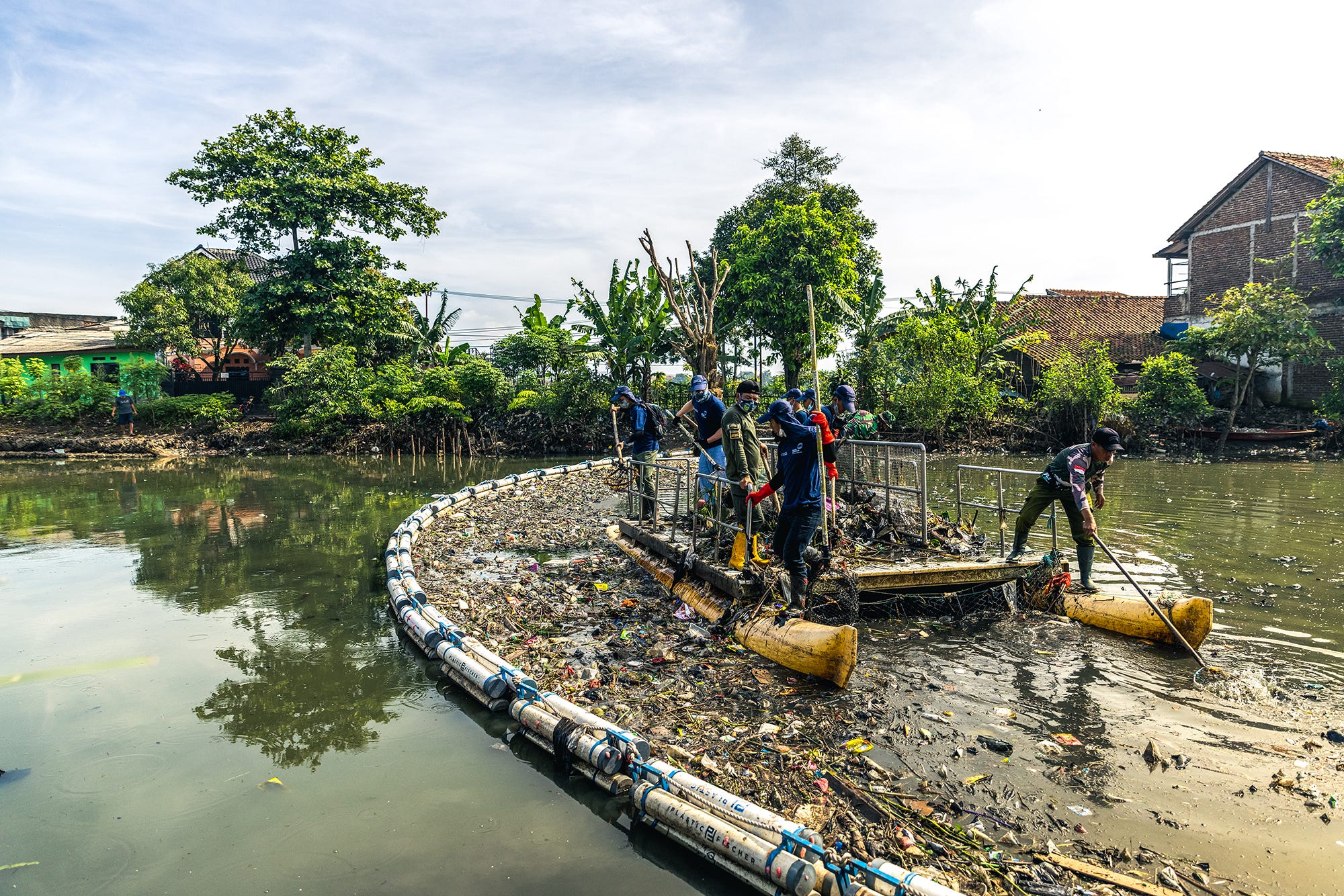
It was built that way on purpose. Plastic Fischer, the German outfit behind the design, was started in 2019 by three students, Karsten Hirsch, Georg Baunach, and Moritz Schulz, after a trip to Vietnam where they watched plastic pile up in the Mekong and came home asking why every proposed fix looked like a research-grant fever dream: autonomous boats, AI-sorting barges, million-dollar pilot budgets. Their answer was what they call the “3L” approach: local, low-tech, low-cost. Parts sourced locally instead of imported. No moving parts to fail. Nothing that needs an engineer on call. The design is open source; anyone can build one.
In Thiruvananthapuram, fifteen of them have been doing exactly that since 2021, dropped into the water at chokepoints along the Karamana, the Killi, and the city’s canal network. The project runs on an unusual partnership: Allianz Services India and Allianz Technology India, the insurance giant’s Indian technology and operations arms, fund and coordinate it, working alongside Thanal Trust, a Kerala environmental nonprofit, the Sustera Foundation, and Plastic Fischer itself, with backing from the Thiruvananthapuram Corporation and state government departments.
The number that makes the boring thing interesting
Four years in, the fifteen booms have pulled out more than 1,000 tonnes of plastic before it could reach the Arabian Sea. Translate that into something a person can picture: roughly 50 million plastic bottles, intercepted one chokepoint at a time, by a device that is, structurally, a fence.
For context on how unusual that is at the technology level: Plastic Fischer’s CEO has said the company’s booms have collected a little over 250 metric tonnes across all its India and Indonesia deployments combined since 2021. Thiruvananthapuram’s own number, over 1,000 tonnes, suggests this particular deployment, with this particular mix of funders and local partners, has outperformed the company’s broader average by a wide margin. The fence is the same everywhere. The difference is who kept it running.
That’s really the story here, more than the hardware.
A floating steel mesh doesn’t maintain itself.
Someone has to empty it before it fills up and starts leaking plastic back into the current.
Someone has to haul the catch to a sorting and disposal point.
Someone has to keep doing that every week, for four years, through monsoons that would make most infrastructure project managers reconsider their life choices.
The technology is the easy part of this story.
The unglamorous, compounding maintenance routine is the hard part, and it’s the part that doesn’t make it into most coverage of plastic cleanup technology.
It’s already being copied
In 2025, the project expanded to three more waterways around the city, Puthenthope, Kadinamkulam, and Veli, on the strength of the first phase’s results. More tellingly, the model is now being replicated well outside Kerala: Mangaluru, Bengaluru, Mumbai, Kanpur, and Varanasi are all adopting some version of the same approach, according to the groups involved.
That’s worth sitting with for a second, because it cuts against how most circularity success stories get told. There’s no patented breakthrough here, no novel polymer, no AI model. There’s a fence design from 2019 that three German students open-sourced, placed in exactly the right chokepoints by people who understood the local waterways, and paired with four years of someone actually doing the unglamorous work of emptying it. The research behind why this matters globally is blunt: just 1,000 of the world’s roughly three million rivers are responsible for nearly 80% of all plastic that reaches the ocean. You don’t need a moonshot to fix that problem. You need boots on the ground at the right 1,000 spots, and a reason to keep showing up.
What this says about Kerala’s rivers, specifically
None of this reverses what happened to the Karamana over the preceding decades: the dams at Peppara and Aruvikkara that throttled its natural flow, the sand mining, the sewage. A TrashBoom doesn’t fix upstream water management or treatment-plant capacity; it catches what’s already floating past. But it does something that matters in its own right: it stops today’s plastic from becoming tomorrow’s ocean statistic while the slower, harder work of fixing the actual sewage and treatment infrastructure (if it happens at all) plays out on its own, much longer timeline.
The people running Thanal Trust and the Allianz teams aren’t claiming to have resurrected a sacred river. They’re claiming something much smaller and, in its own way, more useful: that 1,000 tonnes of plastic that would have reached the sea, didn’t. Fifty million bottles’ worth of “didn’t,” one boom, one week, one empty net at a time, for four years straight. It’s a maintenance schedule that never broke. In circularity, as in most of life, that turns out to be most of the job.
Quick Hits — everything else from today’s digest
Waste & Circularity
Bangladesh just split every plastic product sold in the country into five categories under new EPR rules, with collection targets starting at 15% in year one and climbing to 30% by year five. Miss the six-month registration deadline and it’s audits and suspension, not a warning letter. Source
Delhi’s first compressed biogas plant is now processing 200 tonnes of cattle dung a day at Goyla Dairy, turning waste that used to flow into drains near the Yamuna into vehicle-grade fuel and fertiliser. Source
Energy Transition
India’s solar buildout is accelerating faster than its own history suggests is possible. The first 50 GW took about eight years, the second took three, and the third took fifteen months, pushing installed capacity to 162.15 GW by June 2026. Source
Water & Ocean Systems
Nobel laureate Omar Yaghi’s startup Atoco is launching commercial atmospheric water-harvesting units in the Gulf in the second half of 2026, using porous “reticular” crystals with enough internal surface area (one gram equals a football field) to pull usable water out of desert air. Source
37 governments are backing a pause on deep-sea mining, partly because warming oceans are pushing commercially fished tuna straight into the zones mining companies want to dig, risking sediment plumes and toxic-metal exposure. Source
Climate & Biodiversity
Deforestation alerts in the Brazilian Amazon fell 36% year-over-year, hitting their lowest level since 2016, according to satellite monitoring for the year ending July 2026. Source
Materials, Packaging & Building
India’s textile recycling market could hit $3.5 billion by 2030, according to a Ministry of Textiles report that found the country generates 70.73 lakh tonnes of textile waste annually, with Panipat emerging as the country’s mechanical-recycling hub. Source
Mobility & EVs
India sold its ten-millionth EV since 2017, with penetration more than doubling from 5% to 11% of new vehicle sales since 2022 and monthly volumes crossing 300,000 units for three straight months this summer. Source
Agriculture & Food Systems
ICAR wants India’s food loss rate cut from 15-20% today to roughly 5% by 2047, reframing the fix (better cold chains, packaging, and digitised supply chains) as climate policy rather than just an efficiency upgrade. Source
Policy, Finance & Carbon Markets
Gold Standard now requires every carbon credit of 2026 vintage or later to be issued through Paris Agreement-aligned methodology, with no exceptions for existing project types. It’s a quiet signal that a lot of older credits weren’t held to that bar. Source
Deep Dive
The recycling symbol on every bin on earth was a 1970 design-contest entry by a 23-year-old USC student, built on the 1858 Möbius loop and never trademarked. That’s exactly why it ended up everywhere instead of licensed to one company. Source