


For most of the last decade, “water from air” has lived in the same bucket as flying cars and lab-grown steak: a demo that works beautifully on a conference stage and falls apart the moment someone asks what it costs to run at scale. That bucket just got a lot smaller.
At the Third International Atmospheric Water Harvesting Summit, held this year by Arizona State University’s Global Center for Water Technology, the framing from researchers and founders alike had shifted.
The question was no longer “can this work?”
It was “who’s running this profitably, and where?”
A field that spent two summits arguing about lab efficiency numbers spent its third arguing about deployment logistics, financing models, and grid integration. That’s what a technology sounds like right before it stops being a novelty.
The physics nobody explains well
Every gigalitre of “atmospheric water” comes from one of two approaches. The first, older one is mechanical: run humid air over a cold coil, condense the moisture, filter it — essentially a dehumidifier with a marketing budget. It works, but it’s power-hungry and falls apart in dry climates, which happen to be exactly the places that need alternative water sources most.
The second approach, and the one drawing the real investment right now, is desiccant-based. Instead of brute-forcing condensation with refrigeration, a hygroscopic material — a salt solution, a specially engineered sponge-like solid — grabs water vapor out of the air through chemical affinity, the same way silica gel keeps a shoebox dry. Heat (increasingly solar) then drives the water back out of the desiccant as clean vapor, which condenses into liquid. No refrigerant, far less electricity, and critically, it keeps working in arid air where mechanical condensers give up.
That distinction is why the “lab to field” story is happening now and not five years ago. Desiccant chemistry only became efficient and cheap enough to manufacture at scale recently — and the difference shows up directly in the numbers coming out of field deployments.
An Indian company is one of the ones actually doing it
While the American and Gulf press has spent the last year chasing splashy AWH pilots in Las Vegas and Abu Dhabi, one of the more commercially mature versions of this technology has been running quietly out of Bangalore.
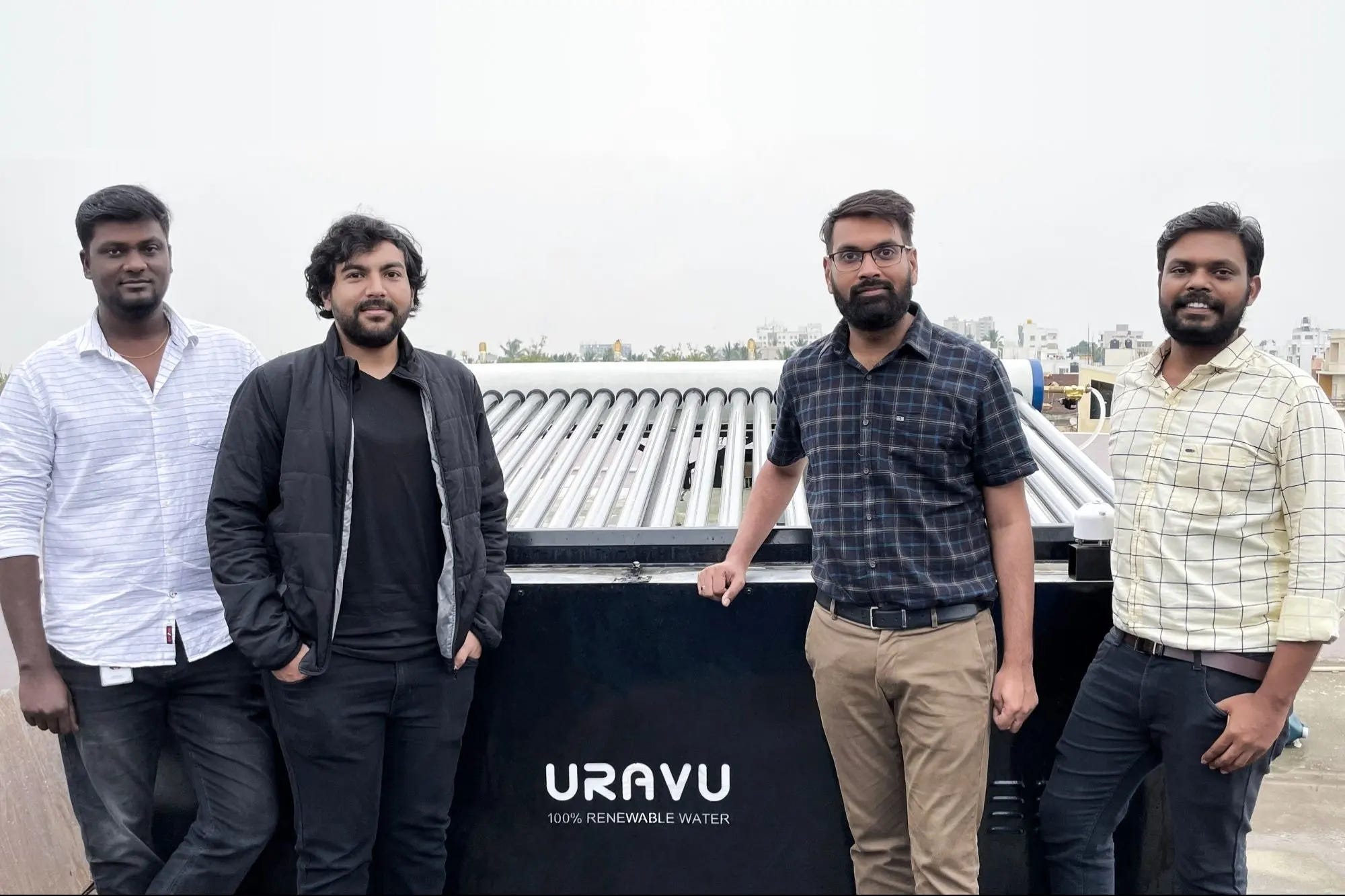
Uravu Labs — started in 2016 as a student project at NIT Calicut — builds its water harvesting around what it calls the Clausius platform: a thermally-driven liquid desiccant cycle that uses a proprietary hygroscopic solution instead of mechanical refrigeration. The company claims roughly 75% lower energy consumption than conventional AWG systems in dry conditions, and its industrial platform is rated at 30,000 liters of distilled water per megawatt per day.
The commercial traction is the part worth paying attention to, because it’s the part almost nobody manages at this stage.
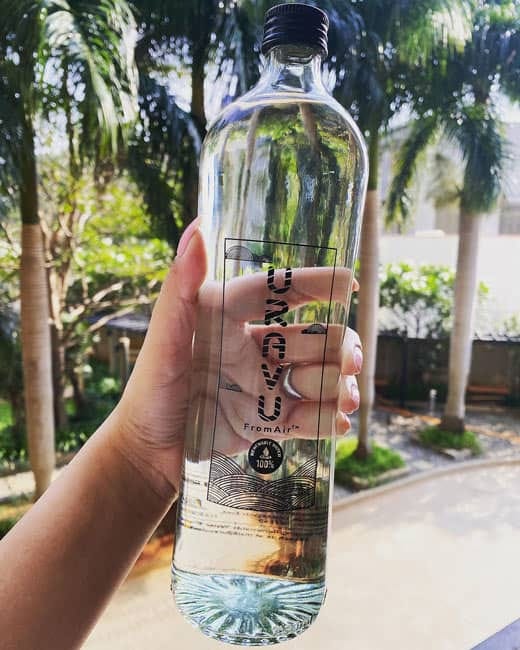
Uravu’s consumer brand, FromAir, has sold more than 3.8 million bottles and is served at close to 100 restaurants and luxury hotels, including The Leela in Bengaluru. On the industrial side, the company is running water-as-a-service pilots with AB InBev and Radico Khaitan — both companies with obvious, self-interested reasons to want a water source that doesn’t compete with community groundwater during a monsoon-dependent year.
There’s a second version of the Clausius platform aimed at data centers, which is arguably the more interesting long-term play. Data centers reject enormous amounts of waste heat and, increasingly, face local opposition over how much water their cooling systems consume. A system that captures that waste heat and turns it into distilled water instead of just venting it into the atmosphere flips a liability into a byproduct. Uravu has been selected for Abu Dhabi’s Hub71 accelerator cohort and says it’s expanding into Japan and the US — both markets where data center water use is becoming a genuine political problem, not just an ESG footnote.
None of this means the economics are solved everywhere. Cost-per-liter still depends heavily on ambient humidity, local electricity or solar availability, and system scale — industrial platforms measured in megawatts look very different from a countertop unit for a household. But “over 3.8 million bottles sold” and “pilots with a listed brewer” are not lab metrics. They’re commercial ones.
Why a waste-management guy is writing about water
It’s tempting to file this under climate tech and move on, but the framing matters for anyone working in circularity. Waste and water have always been treated as separate problems with separate ministries, separate audits, separate funding lines. Atmospheric water harvesting quietly erodes that separation, because its best economics show up exactly where “waste” already exists: waste heat from a data center, waste heat from an industrial process, humid exhaust air from a cooling tower. The input isn’t a river or a borewell. It’s a byproduct that was already being thrown away.
That’s the same logic that underpins every good circularity story — carbon-cured bricks that turn a captured emission into a building material, seaweed packaging that turns an overgrown coastal nuisance into a compostable film. The pattern keeps repeating: the “waste” was never actually waste, just an unpriced input waiting for someone to build the loop.
What to watch next
The honest caveat: nobody at the summit claimed AWH will replace municipal water systems or large-scale desalination any time soon, and it shouldn’t be sold that way. What it’s good at — right now, commercially — is decentralized, off-grid, or supplementary supply: hotels, industrial parks, data centers, disaster response, water-stressed regions without reliable piped infrastructure. It’s a complement to the grid, not (yet) a competitor to it.
The number worth tracking over the next 12 months isn’t a lab efficiency figure. It’s deployed megawatt-capacity and bottled/served volume — the two numbers Uravu is already willing to publish, and the two numbers that separate a genuine field technology from another conference demo. If more AWH companies start publishing numbers like “3.8 million bottles sold” instead of “X% more efficient than 2019,” that’s the signal this has actually crossed over.
Quick Hits — everything else from today’s digest
Policy & Waste
India’s plastic EPR rules just got a lot sharper. Recycled-content mandates for rigid plastics jump from 30% to 60% by 2028-29, flexible plastics from 10% to 20% — and for the first time, resin manufacturers share liability alongside brand owners. Self-reporting is out; independent audits are in. Source
California Waste Solutions is scaling up AI-driven optical sorting at its Oakland and San Jose facilities, adding a new layer of automated material recovery to existing MRF lines. Source
Deep Dive
Recycling is 2,500 years older than you think. A history of the practice running from Bronze Age metal reuse through the 20th century’s manufactured “convenience” culture to today’s circular economy movement. Source
Climate
64,000+ square miles of coral reef, across 71 countries, turn out to be more climate-resilient than a 2018 estimate suggested — using 45,000 coral observations remapped with satellite AI. Only 28% of that resilient reef is currently protected. Source
Cleanups & Social Good
Surfrider’s Dirtiest Beach Day 2026 pulled 44,000 pounds of trash off beaches in a single coordinated day across 50+ cleanups in 13 states. Source
Orleans, Massachusetts became the first community certified “Ocean Friendly” under a new coastal-policy accreditation program. Source
Materials, Packaging & Building
Seaweed and mycelium packaging are scaling past the pilot stage, moving from niche compostable alternatives toward mainstream commercial packaging lines. Source
Seratech’s carbon-capturing bricks cure overnight at room temperature using captured CO2 and a magnesium binder, instead of firing clay at 1,200°C — locking carbon into the brick rather than releasing it. Source
Seven materials are reshaping green building this year, including Ferrock, self-healing concrete, and cross-laminated timber (CLT). Source
Energy Transition
Solar cells just hit 130% quantum efficiency using a singlet-fission process that lets one photon generate more than one electron — a genuine physics breakthrough, not an incremental gain. Source
Wind turbines are being reinvented from the ground up — airborne, floating, and bladeless designs are all moving from concept to pilot. Source
Water, Land & Mobility
OceanWell is testing subsea desalination pods 400 meters underwater, using natural ocean pressure to filter seawater before it ever reaches the surface — potentially cutting the energy cost that makes conventional desalination so expensive. Source
The USDA unveiled a $700 million regenerative agriculture program, funding farmers who adopt soil-health practices that sequester carbon and reduce input costs. Source
India now has more than 4,000 EV battery-swap stations, sidestepping the charging-time problem that still slows EV adoption elsewhere. Source
Advanced Mechanisms
AI and robotics are reshaping e-waste recovery facilities, with cyber-physical systems now sorting and dismantling electronics at a precision manual labor can’t match. Source
A newly engineered fusion enzyme is making polyester textile recycling commercially viable for the first time, breaking down a fiber that has resisted cost-effective recycling for decades. Source
Evergreen
The IEA flags EV battery recycling as a critical-minerals security issue, not just an environmental one — countries are racing to secure domestic recovery capacity for lithium, cobalt, and nickel. Source
Voluntary carbon market forecasts for the same year disagree by as much as 14x across major analysts — a reminder of how immature carbon-market price discovery still is. Source
This is the feature + roundup edition of the Circularity Digest, built by the research team of Cercle X, headed by Vishnu Vardhaan.
Loved reading this? Share it with your friends and your peers, and colleagues. Let’s build a wave of circularity across the world.